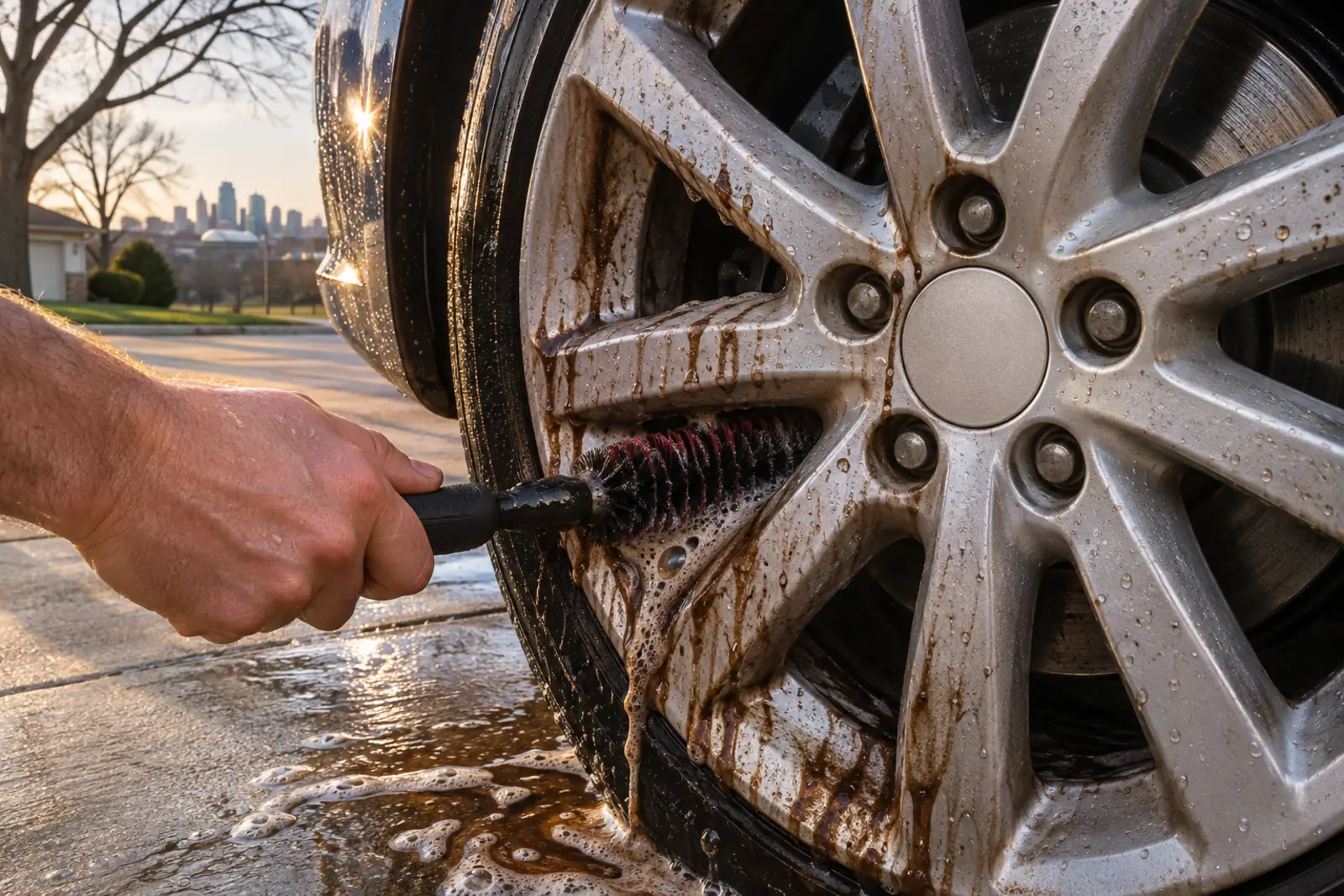
Brake dust is iron. When brake pads press against rotors, they shed microscopic metallic particles that land on your wheel face while still hot, fusing to the clear coat or bare metal at a molecular level. Leave those deposits for a week of Kansas City driving - through road salt residue in winter, construction debris year-round, and iron-laden surface runoff from the metro's aging infrastructure - and you have contamination that a garden hose will never dislodge.
That baked-on brown haze coating most Kansas City wheels is not just dirt. It is a mixture of ferrous brake particulate, road salt crystalline deposits, industrial fallout, and rubber transfer from the tires themselves. Each of those contaminant types bonds differently to wheel surfaces and requires different chemistry to remove safely. This is why dedicated wheel detailing is a service category of its own - distinct from a standard wash and from full paint correction - and why understanding what it involves will help you get the right result for your specific wheels.
This guide walks through the full scope of professional wheel detailing: the chemistry behind decontamination, how different wheel finishes change the approach, what ceramic wheel coatings actually do, what proper tire care looks like, and what you should expect to pay at a reputable shop or mobile detailer in the Kansas City area.
Why Kansas City Is Especially Hard on Wheels
Every car accumulates brake dust. Kansas City drivers deal with an elevated version of that challenge for several specific reasons.
First, the city's stop-and-go arterial traffic on roads like State Line Road, 103rd Street, and the stretch of Ward Parkway through the Country Club District generates more brake events per mile than highway cruising. More braking means more heat, more particulate, and faster accumulation on the inboard and outboard faces of each wheel.
Second, Kansas City winters use significant quantities of road salt and liquid brine on major corridors from roughly mid-November through early March. Salt is hygroscopic: it pulls moisture from the air and holds it against metal surfaces. On unprotected or marginally protected wheel faces, that moisture-and-salt combination accelerates the oxidation of iron brake dust already embedded in the finish. The result is a reddish-brown staining that penetrates deeper than what appears on the surface.
Third, the metro has seen sustained construction activity across highway expansion and infrastructure projects for years. Construction zones shed iron-rich debris - dust from cutting, grinding, and welding operations nearby - that settles on paint and wheels of vehicles passing through or parked adjacent to work sites. If you commute through or near active roadwork on I-70, I-435, or the downtown interchange, your wheels are picking up that fallout even when you are not braking at all.
None of this means Kansas City wheels are impossible to maintain. It means they benefit significantly from a methodical cleaning and protection approach rather than a drive-through spray and a hope.
Know Your Wheel Finish Before Touching It With Anything
The single most important step in wheel detailing is identifying the finish, because the wrong product on the wrong surface causes permanent damage. The major categories you will encounter on Kansas City vehicles:
Clear-Coated Painted Wheels
By far the most common finish on vehicles from roughly 2000 onward. The wheel face is painted and then sealed with a clear coat similar to automotive paint. These wheels are durable, respond well to pH-neutral cleaners, and can accept the same coatings used on painted bodywork. Clear coat failure - typically appearing as peeling or flaking near the wheel edges - is usually caused by using harsh alkaline wheel cleaners repeatedly, by neglecting decontamination so iron deposits pit through the clear, or by high-pressure washing too close to the edge where the clear coat is thinnest.
Chrome-Plated Wheels
True chrome plating involves a layer of nickel followed by chromium electroplated onto the wheel substrate. The mirror finish is striking but fragile in ways many owners do not realize. Chrome is porous at a microscopic level, which means iron and salt deposits that sit on chrome for extended periods can cause pitting that cannot be polished out. Chrome-plated wheels require pH-neutral cleaners, should never be treated with iron-removal chemicals unless the product is explicitly stated safe for chrome, and benefit enormously from a dedicated sealant that blocks moisture from reaching the surface.
Polished Aluminum
Polished aluminum has no protective coating applied at the factory. The mirror finish comes from mechanical polishing to a reflective surface. Without protection, polished aluminum oxidizes quickly - developing a dull, chalky appearance - especially in a climate with acid rain, road salt, and significant UV load like Kansas City summers deliver. These wheels need a sealant or wax applied at every detail, and they typically require periodic re-polishing to remove oxidation before sealing.
Powder-Coated Wheels
Powder coating is an increasingly popular aftermarket and OEM finish, particularly on trucks and performance vehicles. The coating is thermally bonded, making it more chip-resistant than standard paint. Powder-coated surfaces are generally tolerant of a wider pH range than clear-coated paint, but prolonged exposure to alkaline brake dust removers or strong iron dissolvers can dull the finish over time. Treat powder-coated wheels similarly to clear-coated painted wheels and you will not go wrong.
Matte and Satin Finishes
Matte or satin factory finishes require extra attention because any product that adds gloss - including many tire dressings that spray overspray onto the wheel face - will create visible shiny spots that cannot be removed without refinishing. Use only matte-compatible products on these wheels and be careful about overspray from adjacent surfaces during the detail process.
What Professional Wheel Detailing Actually Involves
A thorough wheel detail is not a quick spray-and-rinse. Done properly, it involves at least six distinct stages, and skipping any of them leaves the job incomplete.
Stage 1: Cool Rinse Before Everything Else
Wheels should be cool to the touch before any product is applied. Applying wheel cleaner or iron remover to a hot wheel - immediately after driving - causes rapid evaporation that leaves residue and can etch finishes. A thorough rinse with cool water also knocks off loose debris, so you are not dragging gravel and grit across the wheel face with a brush later in the process.
Stage 2: pH-Neutral Wheel Cleaner
The first chemical pass uses a pH-neutral or mildly acidic dedicated wheel cleaner applied to the entire surface - spoke faces, the barrel where accessible, lug nut pockets, and the visible rim edge. The product is allowed to dwell for one to two minutes, then agitated with a soft brush before rinsing. This step removes the bulk of loose brake dust and road film, preparing the surface for the more targeted decontamination step that follows.
Stage 3: Iron and Fallout Removal
This is the step most people skip and the most important one for Kansas City vehicles. An iron-reactive fallout remover applied after the initial cleaner rinse chemically dissolves embedded ferrous particles. Good-quality iron removers change color - typically from clear or yellow to purple or reddish - as they react with iron, giving you visual confirmation that contamination was present and is being neutralized. The reaction takes three to five minutes, after which the wheel is agitated and rinsed thoroughly. For heavily contaminated wheels, this step alone can transform the appearance more dramatically than any other.
Stage 4: Dedicated Brush Work
Three brush types typically see action on a thorough wheel detail: a long-handled barrel brush that reaches inside the wheel to clean the back face of each spoke and the inner barrel surface; a smaller lug nut brush for the threaded pockets and center cap area; and a soft-bristle wheel face brush for the outer surface. Quality brushes have flagged - split-tip - bristles that hold product and do not scratch. Cheap brushes with hard nylon bristles will create fine scratches in clear-coated finishes that become visible under direct sunlight.
Stage 5: Rinse, Dry, and Inspect
After agitation, wheels are rinsed thoroughly from top to bottom, then dried using a clean microfiber towel or dedicated wheel-drying tool. Drying is not optional - water spots on wheels are just as problematic as water spots on paint, and Kansas City's tap water is moderately hard, leaving visible mineral deposits if water air-dries on the surface. After drying, each wheel is inspected under a light for remaining contamination, pitting, clear coat failure, or surface scratches that may need attention before protection is applied.
Stage 6: Protection
The final stage varies based on what protection level was chosen: a traditional wax or synthetic sealant for a maintenance detail, or a ceramic wheel coating for longer-term protection. The right choice depends on how the vehicle is used and how much ongoing maintenance the owner wants to do. Both are covered in detail in the sections below.
Iron Fallout Removal: The Step That Changes Everything
Iron fallout removal deserves extended discussion because so many Kansas City drivers have never had it done, and because the results often surprise people who assumed their wheel staining was permanent.
When iron particles land on a wheel surface at high temperature, they do not just sit on top of the finish. They partially embed themselves, and the constant heat cycling from braking accelerates that bonding process. After a few weeks, standard wheel cleaners - even aggressive ones - cannot dissolve what is now a bonded contamination layer. You can scrub until your arm gives out and the brown haze will remain.
Iron fallout removers work through a targeted chemical reaction: they contain compounds that chelate (bind to) iron ions, making those particles water-soluble so they can be rinsed away. The color change you see as the product dwells - the purple or reddish color that bleeds across the wheel face - is literally iron contamination being dissolved out of the surface. The reaction is specific to ferrous metal, which means it is safe for aluminum and clear-coated surfaces when used as directed. Always verify product compatibility before use on chrome or bare metals, as not all formulations are appropriate for all finishes.
For a vehicle that has never had iron removal done, the first treatment often removes contamination the owner had assumed was permanent discoloration. For regular maintenance, an iron removal step once or twice per year keeps KC road deposit buildup from reaching the critical threshold where it starts pitting clear coats and plating. It is worth noting that iron fallout lands on painted body panels as well - a full decontamination detail treating both paint and wheels is worthwhile at least once annually.
Ceramic Wheel Coatings: Long-Term Protection Worth Understanding
Standard waxes and sealants applied to wheels typically last four to eight weeks before the heat from braking degrades them. A wheel-specific ceramic coating - a silica-based formula engineered to withstand brake heat - can protect wheel surfaces for one to two years or longer with proper maintenance.
How ceramic wheel coatings work is fundamentally the same as ceramic coatings on paint: the product bonds chemically to the wheel surface, forming a hard, hydrophobic layer that makes water bead aggressively and prevents brake dust and road grime from bonding directly to the finish. The practical result is that brake dust, which previously baked on after a week of driving, now rinses off with a hose after a week instead - the contamination cannot achieve the same molecular grip on a coated surface.
What ceramic wheel coatings do not do: they do not prevent brake dust from landing on the wheel, and they will not keep wheels perfectly clean between washes. What they do is dramatically reduce the time and effort required to clean the wheels at each wash, and they create a barrier that prevents iron particles from embedding in the underlying finish during those gaps between cleaning sessions.
Application of a ceramic wheel coating requires the same surface preparation as any ceramic coating application: thorough decontamination including iron removal, surface inspection, and in some cases light polishing to remove fine scratches before the coating locks them in. The coating is typically applied by hand and allowed to cure. Some products require extended curing time before the vehicle should be driven or washed. A professional applying wheel coating to all four corners will generally keep the vehicle for several hours to a full day.
Pricing for ceramic wheel coating in the Kansas City market varies considerably based on the product used, wheel type and size, and whether the service is bundled with a full detail or paint coating package. Verify current pricing directly with the detailer, as rates reflect both product cost and labor. The most important question to ask is whether iron decontamination and any necessary polishing are included in the preparation work - a ceramic coating applied over contaminated or scratched wheels will seal those defects in permanently.
Tire Care: More Than Tire Shine
Tire detailing is often treated as an afterthought - spray something glossy on the sidewall and move on - but proper tire care matters for both appearance and longevity in Kansas City's climate.
Tire Dressing Types
Tire dressings range from water-based formulas with a natural matte or satin finish to solvent-based high-gloss products that produce the wet look common on show cars. The choice depends on personal preference, but there are practical considerations beyond aesthetics.
Water-based dressings applied by hand with a foam applicator rather than sprayed and wiped last longer, do not sling onto wheel faces and paint when driving at speed, and do not interact negatively with the rubber compounds in modern tires. High-solvent products can dry out rubber over time with repeated heavy use, though an occasional application is not going to cause visible harm. The more important variable is application method: a dressing applied to the sidewall only - not onto the tread - and given time to absorb before driving eliminates the flinging issue that leaves greasy spots on wheel faces and quarter panels.
Tire Sidewall Browning
The orange-brown discoloration that appears on tire sidewalls - even on relatively new tires - is not caused by tire dressing or neglect. It is caused by antiozonant chemicals built into the rubber compound by the tire manufacturer. These chemicals migrate to the surface of the rubber to protect it from ozone degradation, and ozone levels in Kansas City during summer months are meaningful enough that this migration happens year-round. Some tire dressings temporarily mask the browning; none eliminate the underlying chemistry. Keeping tires clean and applying a UV-blocking dressing on a regular schedule minimizes its visual impact.
Sidewall Cracking and Long-Term Protection
Sidewall cracking is a sign of rubber degradation from ozone exposure, UV radiation, low inflation, and age. Tires that sit outside year-round in a Kansas City climate - exposed to summer UV and winter cold cycling - age faster than garage-kept tires. While no dressing reverses existing cracking, UV-protective dressings applied regularly to clean tires slow the degradation process. If your tires show significant radial cracking in the sidewall, have them inspected by a tire shop regardless of remaining tread depth - sidewall integrity is a safety matter.
Wheel Wells: The Most Overlooked Area in a Wheel Detail
The inner wheel arch and wheel well liner trap a significant amount of Kansas City road debris - mud, salt, gravel, and biological material from road runoff. In winter, that mixture packs into the wheel well and sits in contact with the metal edges of the arch, accelerating rust at the paint-metal seam where corrosion is hardest to treat once established.
A thorough wheel detail should include jet-rinsing the wheel wells to remove packed material, followed by brush agitation if debris is caked in. Some detail packages include an application of a dressing or coating to the plastic wheel well liner, which keeps it from turning gray and cracking under UV exposure and makes future cleaning significantly easier.
If you notice rust staining at the seam where the inner wheel arch meets the body panel, flag that to your detailer and potentially to a body shop as well. Early-stage surface rust can be treated with minimal intervention. Left unaddressed through another Kansas City winter, it works inward from the edge in a process that becomes increasingly expensive to reverse.
Brake Caliper Detailing
High-performance vehicles and many modern trucks and SUVs come with prominently visible calipers behind open-spoke wheels. For daily drivers, calipers accumulate the same brake dust and road contamination as the wheel face, and they run extremely hot during normal driving.
Caliper cleaning is part of a barrel-focused wheel detail - a good detailer will clean caliper faces with a heat-resistant cleaner and appropriate brushes when doing the inner barrel work. Beyond cleaning, some owners choose to have calipers painted with high-temperature paint as part of a full wheel package. Caliper painting (not to be confused with caliper covers, which are a different product) uses specialized paint designed to withstand sustained heat. Done properly, it provides a clean appearance visible through the spokes and - because the caliper surface is now coated rather than bare cast iron - it is significantly easier to clean during future details.
Matching the Service Level to Your Situation
Not every vehicle or every situation calls for the same scope of wheel work. A rough breakdown to help you calibrate what to ask for:
Regular Maintenance Washing
If your wheels were properly decontaminated and coated within the past six to twelve months and you wash the car every two to four weeks, maintenance wheel cleaning at each wash is sufficient: pH-neutral cleaner, brush agitation, rinse, dry, done. The coating keeps contaminants from bonding, so the cleaner does its job easily without additional steps.
Annual or Semi-Annual Decontamination Detail
For most Kansas City drivers who wash the car occasionally but do not follow a regular professional detail schedule, an annual or semi-annual dedicated wheel decontamination - including iron removal, full brush work including the barrel, and fresh sealant or wax - will prevent the gradual buildup that leads to permanent staining and clear coat damage. After KC winters in particular, a spring decontamination removes road salt residue and iron deposits before they have another warm season to bake further into the finish.
Ceramic Wheel Coating Package
If you have recently purchased a vehicle, just had wheel damage repaired or refinished, or have wheels you want to maintain with minimal effort going forward, a one-time ceramic wheel coating applied over fully decontaminated and prepared surfaces makes ongoing maintenance significantly easier. It is worth having done as a standalone service or as part of a larger protection package when the vehicle is new or freshly detailed - the investment in thorough surface prep is essentially wasted if it is not locked in with a durable coating.
DIY Wheel Maintenance Between Professional Details
Professional decontamination and coating application deliver results that exceed what most people can achieve at home, but wheel maintenance between visits is entirely manageable yourself with the right supplies and habits.
At minimum, keep a pH-neutral wheel cleaner, a soft wheel brush, and a microfiber drying towel available. After each Kansas City winter drive involving salted roads, a quick rinse of the wheels - even just running water from a hose before the car sits overnight - significantly reduces accumulation. You do not need a full wash every time, but preventing packed salt from sitting against the wheel finish for days at a time matters for long-term preservation.
If you purchase an iron fallout remover for home use, the purple color change you see as it dwells is the product doing exactly what it is supposed to do. No color change after the previous treatment was thorough means the surface was clean - both are useful pieces of information about where your wheels stand. Iron fallout removers for home use are widely available from automotive suppliers; look for products that specify safe use on the type of finish your wheels have, and always test on a small area if you are unsure.
Between professional coating applications, a spray sealant applied to clean, dry wheel faces after each detail adds meaningful short-term protection and takes about two minutes per wheel. It will not replicate a ceramic coating's durability, but it creates a barrier against immediate re-bonding after each wash and extends the intervals between thorough decontamination sessions.
- Rinse wheels before they cool after salt exposure - do not let brine dry on the surface
- Use separate wheel brushes and towels - never use them on paintwork afterward
- Apply tire dressing with an applicator pad, not by spraying directly onto the tire
- Inspect wheel wells after winter for packed debris and early rust at the arch seam
- Ask your detailer whether iron removal is included in any service before booking
Frequently Asked Questions
How often should I have my wheels professionally detailed in Kansas City?
For most drivers, a full professional wheel decontamination once or twice per year is appropriate - with spring being the most critical timing, right after road salt season ends. If your wheels carry a ceramic coating, annual maintenance is typically sufficient. Without any coating protection, more frequent professional cleaning prevents the deep iron staining that becomes very difficult to remove without polishing or refinishing the wheel surface.
Can I use the same cleaner on chrome and painted wheels?
No, and mixing up the two is one of the most common ways wheels get permanently damaged. Harsh alkaline brake dust removers and iron dissolvers formulated for painted wheels can etch chrome plating and cause blistering or pitting that cannot be reversed. Chrome-plated wheels need a pH-neutral cleaner specifically. If you are unsure what finish your wheels have, check the owner's manual or ask a detailer before applying any chemical product to the surface.
How long does a ceramic wheel coating last?
Most professional-grade ceramic wheel coatings are rated for one to two years under normal driving conditions, though actual service life depends heavily on maintenance habits. Washing with pH-neutral products and avoiding harsh alkaline or acidic cleaners keeps the coating active longer. You will notice when protection is fading - water stops beading on the wheel face and brake dust starts sticking more aggressively - as a clear signal it is time for renewal.
What is iron fallout and why do Kansas City cars get so much of it?
Iron fallout is microscopic ferrous particles shed during braking that land hot on nearby wheel and paint surfaces, bonding as they cool. Kansas City's combination of dense arterial traffic with frequent stop-and-go braking, iron-rich debris from active highway construction zones, and rail freight corridors running through the metro means vehicles here accumulate more iron contamination than in lighter-traffic environments. The fallout embeds in both wheel finishes and paint finishes alike - iron removal is worth doing across the full vehicle exterior, not just the wheels, at least once per year.
Does wheel detailing include the inside of the barrel?
It should, but always confirm before booking. Some shops clean only the outward-facing surface of the wheel. A thorough detail includes barrel cleaning with a long-handled brush, caliper face cleaning, and inspection of the inner edge for early corrosion. Specifically ask whether the inner barrel and caliper area are included in the quoted service - if the shop does not mention it unprompted, ask what it costs to add before committing.
Will tire dressing damage my tires over time?
Water-based, alcohol-free tire dressings applied with an applicator pad rather than sprayed directly cause no meaningful rubber degradation with regular use. Petroleum-solvent-heavy products used heavily over many years can dry out rubber compounds, but the application frequency most owners practice is not a practical concern. The bigger variables for tire longevity are inflation pressure, UV exposure, and age - tires over six years old should be inspected by a tire professional regardless of remaining tread depth.
If your wheels are overdue for a proper decontamination - or if you have never had iron removal done and are curious what your finish actually looks like underneath - the contact page is a good place to start. A quick description of your vehicle, wheel type, and what you are seeing will help any KC detailer point you toward the right service level.